.png)
August 25, 2026
Thought Leadership
What Happens When Frontier Large Language Models Try to Connect a Steel Structure?
Expectations for frontier AI large language models (LLMs) from the major labs are enormous and largely justified. So, can they connect a steel structure?
This is the problem driving ConnectionAI. Recently we challenged two frontier models, Anthropics's Claude Fable 5 and OpenAI’s GPT-5.5, to try and solve it. The task was straightforward. Take an unconnected structural steel model, find the joints and connect the 3D model. We ran it on over 1,000 connections across real construction projects, and this is what we discovered.
LLMs believe they can connect a steel structure, fast
Both models attacked the task without hesitation and completed every run, producing a supposedly “fully connected” structural steel IFC (Industry Foundation Classes) model in one to three minutes. They are fast. They also accurately located over 98% of the joint conditions, meaning they correctly understood the scope of the problem they were tasked with solving.
Every single connection generated by the LLMs was unusable
A picture paints a thousand words, so we pulled some examples to help explain what actually happened when a frontier LLM tried to connect a steel structure.
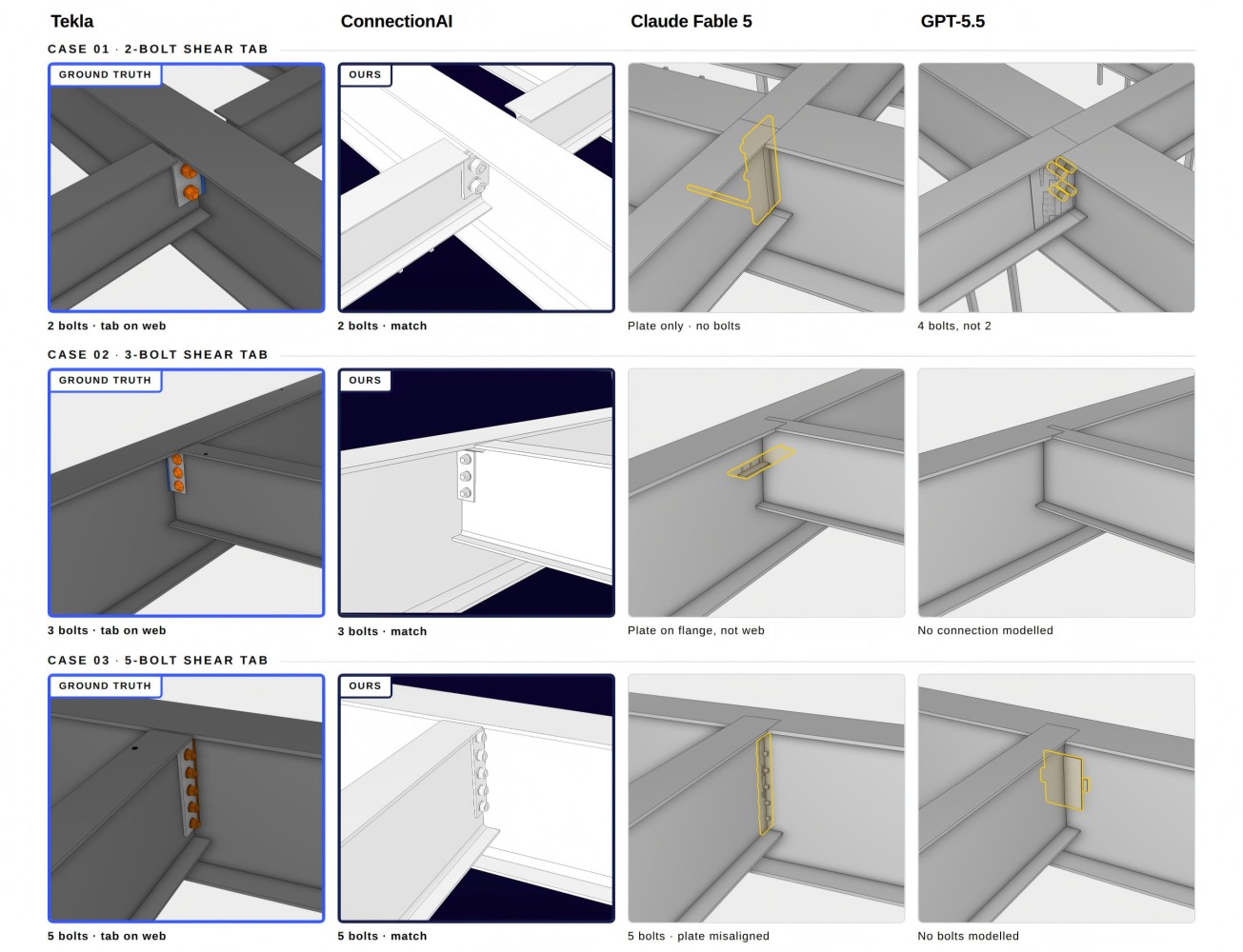
- No LLM was able to create actual IFC connectivity in their 3D model, making the output completely unusable by the industry.
- Beam treatment was totally ignored. No cuts or copes. The output is fundamentally unbuildable.
- GPT-5.5 had a tendancy to locate connections at the origin point (0,0,0), rendered at 1/1000th the correct scale.
- Overlapping plates, unseated plates buried in webs, bolts rendered as pegs, cylinders and even cubes, and floating welds were a handful of the hallucinations we identified.
Why the steel industry deserves a purpose-built frontier AI model
A confidently wrong model does not save time. It moves the work downstream and adds a massive validation burden that no fabricator, detailer, or engineer should have to carry.
These are not tuning problems. A steel connection is a spatial, geometric, constraint-bound engineering artifact. LLMs are sequence prediction engines. They generate increasingly plausible-looking tokens, not buildable connections.
The structural steel industry operates at LOD 400, where every plate thickness, bolt pattern, cope dimension, and weld callout must be fabrication-ready and code-compliant. That level of precision demands an AI model trained on the realities of the domain, not one that has only read about it.
General-purpose intelligence is extraordinary for general-purpose problems. Steel connections are not one of those problems. The industry deserves AI that was built from the ground up, on real construction data, on the language of steel.
It’s called the Steel Brain, and that is what we are building at ConnectionAI.
